
On Letting Go, The Other Side of Knife Collecting
Posted by Harley on 24th Apr 2026
I have written before about the nature of collecting, and in particular, the peculiar depth of knife collecting, how these objects become more than tools, more than possessions, but something closer to Totems. That much still rings true to me.
And yet, there is another side to this story. A quieter, less comfortable truth that I suspect many collectors recognise, but few are especially eager to articulate.
I do not like to think of myself as a collector.
There is something about the word that sits uneasily with me. It conjures images of compulsion, of accumulation for its own sake, drawers filled, shelves burdened, objects multiplying beyond reason. You can't take these things with you when your time is up, the idea of family members having to pour through mountains of meaningless nick-nacks troubles me deeply.
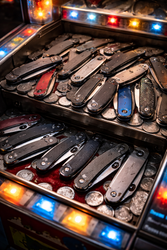
And yet, despite this resistance, I find myself in possession of a collection that has long since crept into triple digits.
So how does one reconcile that?
My own answer, or perhaps my justification, has always been that I never buy for the sake of buying. I do not chase dopamine hits, nor do I feel compelled to complete sets, or to ensure there is always something new in the post. I buy what interests me. What intrigues me. What I want to understand.
Knives, for me, are experiences as much as objects.
Different grinds, different steels, different makers, each has something unique and potentially special to offer. To handle them is to learn. To carry them is to live with them. And in that sense, my collection doesn't feel like a hoard but rather a kind of ongoing story with newcomers, passerbys and departures.
But even with that mental framing, there are moments of when I open a drawer or a case and feel something closer to suffocation than satisfaction.
Too many pieces. Too much redundancy. Too many knives that, if I am honest, no longer excite me in the way they once did.
The collection, at times, feels less like a curated set of meaningful objects and more like noise.
And that, I think, is the point at which collecting loses its way.
Because if knives are Totems, if they are meant to carry meaning, identity, and presence, then a drawer full of forgotten pieces is clutter.
This is where I have come to believe in what I think of as the circular knife economy.
Collecting, if it is to remain healthy, cannot simply be about acquisition. It must also be about letting go.
There is something deeply cathartic in letting go of a knife that no longer speaks to you. Not because it is flawed, nor because it lacks quality, but simply because your relationship with it has run its course.
To pass it on is not a loss. It is a continuation. You must not think of it in terms of 'would I rather have this, or not have it?' because you'll always choose the former. What you must ask yourself is 'would I rather have this, or something better?'.
That knife, which sits idle in your drawer, has the potential to become someone else’s daily companion. Someone else’s first proper piece. Someone else’s Totem.
And in its place, you create space, not necessarily to fill immediately, but to breathe. To refine. To condense your collection into something sharper, more intentional, more truly reflective of who you are.
A handful of exceptional pieces will always carry more meaning than a hundred that barely register.
This is not about rejection of collecting, but about its evolution.
Out with the old, yes but not carelessly. Thoughtfully. Deliberately. With the understanding that letting go is as much a part of the process as acquiring.
Of course, the practicalities of selling can often be enough to prevent action. The photographs, the listings, the messages, the uncertainties around shipping and regulations, it can all feel like more trouble than it is worth. So the knives remain where they are. Static. Unused.
But it need not be that way.
There are simpler routes. More straightforward ways to reintroduce movement into what has become stagnant. To turn dormant objects back into something active, whether that is cash in hand or the opportunity to pursue something that genuinely excites you.
The important thing, the thing I would gently encourage, is not to feel stuck.
You are not beholden to your collection. You are not obliged to keep what no longer resonates. And there is no virtue in holding onto objects out of inertia alone.
If knives are indeed Totems, then they should remain alive with meaning.
And sometimes, the most meaningful thing you can do… is let them go.
If you do find yourself looking at your collection with that familiar sense of weight, drawers that no longer inspire, pieces that have quietly outstayed their welcome, it may be time to act on it.
Parting with knives in the United Kingdom is not always as straightforward as it ought to be. Between age verification requirements, shipping restrictions, platform rules, and the inevitable time-wasters that accompany private sales, the process can quickly become more burdensome than the knives themselves. It is often enough to discourage even the most well-intentioned attempt at thinning the herd.
That is precisely where ArcticKnife comes in.
If you have pieces you are ready to move on from, you need only reach out. There is no need for carefully staged photographs, no drawn-out listings, no navigating the legal intricacies on your own. Simply let us know what you have, and we will provide a fair, considered evaluation and, if it suits you and meets our criteria, a straightforward cash offer.
It is, in essence, a way to return your collection to motion. To release what no longer serves you, without friction or fuss, and to allow those pieces to find new life in the hands of someone who will value them afresh.
A collection should feel like a pleasure, not a burden. If yours has begun to tip the other way, consider this your quiet encouragement to redress the balance.
Reach out for help info@arcticknife.com