
Spyderco Amsterdam Meet 2026 – A Rare Look Inside Spyderco’s Future
Posted by Harley on 10th Mar 2026
Earlier this year I had the incredible privilege of attending the Spyderco Amsterdam Meet 2026, one of the most unique gatherings in the knife world. It’s an event that many enthusiasts have heard about but relatively few ever get to attend in person. Places are extremely limited and typically booked well in advance, so when a last minute cancellation opened up a spot I jumped at the opportunity. As someone who has spent years collecting, using and selling Spyderco knives through ArcticKnife, the chance to attend felt genuinely special.
The Amsterdam Meet is organised each year by Mr. Blonde, also known within the community as SpyderCollector. What began years ago as a relatively small gathering of Dutch Spyderco enthusiasts has grown into a truly international event. On Sunday 22 February this year, a room full of dedicated Spyderco fans gathered in Amsterdam to meet Eric Glesser, Spyderco’s CEO and lead designer, along with International Sales Manager Lisa Underwood. The purpose of the meet is simple but incredibly exciting. Eric brings with him a large number of knives that are currently in development and presents them to the group, giving attendees a rare opportunity to see what Spyderco has been working on long before the public ever hears about it.
This year Eric brought approximately seventy knives in various stages of development. Some of these were production samples that are expected to reach the market relatively soon, perhaps with only minor refinements remaining before final release. Others were still in the concept stage, representing designs that had only recently passed through initial engineering and were still evolving. Eric also brought a few knives that had come directly from custom makers who had submitted their designs to Spyderco for potential collaboration. Being able to see these knives together offered a fascinating insight into the development process, from early prototype all the way through to near production versions. Several attendees who had been to previous Amsterdam Meets commented on how interesting it was to recognise designs that they had seen as prototypes in earlier years, now significantly refined and much closer to becoming finished products.
Because these knives are still proprietary designs, photography was not allowed during most of the event. This ensures that Spyderco can continue refining the designs without prematurely revealing them to the wider market. As Eric explained during the presentation, unforeseen challenges can arise at any stage of development which sometimes leads to delays while issues are resolved.
The presentation itself was easily the highlight of the day. Eric walked us through the knives he had brought, but rather than simply presenting them one after another, each design became the starting point for a broader discussion. A small design detail might lead to a fascinating explanation about manufacturing processes, lock geometry, blade steels or Spyderco’s approach to product development. Questions from the audience often sparked deeper conversations and stories from Eric about how particular designs came into existence. At times it felt less like a product presentation and more like a series of informal masterclasses in knife design, manufacturing and business philosophy. It was impossible not to leave with a deeper appreciation of how much thought, experimentation and iteration goes into every knife Spyderco produces.
There were far too many interesting knives shown during the meet to describe them all in detail, but a few stood out to me personally. One of my favourites was a design by Shawn Houston that will apparently be the last Spyderco knife produced using CPM 15V steel. The knife felt exactly like what you would expect from Shawn Houston’s work, practical, ergonomic and designed first and foremost as a serious cutting tool. Given the extraordinary performance CPM 15V is known for, I suspect this knife will become highly sought after among enthusiasts and collectors once it is released.
Another particularly exciting steel related development was Spyderco’s growing interest in MagnaMax. During the presentation it became clear that Spyderco sees MagnaMax as a potential successor to steels such as S30V, S35VN and S45VN across parts of their range. MagnaMax appears to offer a superb balance of properties, combining excellent corrosion resistance with outstanding edge retention and strong overall toughness. If the gradual rollout of this steel continues as planned, MagnaMax could become one of the defining steels for the next generation of Spyderco knives. Another interesting utterance was Spydercos investment in further CNC capability to produce more hollow ground blades with the hope of hollow grinds being rolled out across large parts of the product range.
Along with a slew of Lil' models such as the Lil' Kapara, Lil’ Smock, Lil’ Slym, Lil’ Starmate, Lil’ Hundred Pacer, one prototype that sparked a lot of curiosity was the Lil' Kapara Slipit. This knife uses a fascinating hinged back spring mechanism inspired by the back lock, but functioning as a non locking slipjoint. The engineering behind it is extremely clever and could make it particularly attractive in markets where locking knives are more restricted. This should be UK legal carry so it's definitely one to look out for.
I was particular fond of a possible collaboration with Gudy Van Poppel that would take inspiration from traditional European folding knives. The design language felt very different from typical Spyderco models and could appeal to collectors who appreciate more traditional aesthetics combined with modern materials and manufacturing.
Fans of larger classic Spyderco designs will be pleased to hear that the Chinook appears to be returning in the form of the Chinook 5, which looks like a worthy successor to the Chinook 4, calling back to the shape and proportions of earlier models. It will have a compression lock and will be made in Golden.
The Edgerati shown with carbon fibre scales looked particularly striking and will almost certainly prove popular when it eventually reaches production. Another interesting design was the Canadian Penknife, which is essentially a scaled up interpretation of the UK Penknife pattern.
Spyderco is also working on an Endela 2, which Spyderco feel could well become one of the brand’s most practical everyday working knives. The design maximises usable cutting edge while still allowing the user to choke up safely with the forefinger close to the blade for controlled work. In many ways it felt like a knife that could rival the Para Military 2 as a default choice for people wanting a reliable, all purpose folding knife.
One of the more intriguing developments shown during the meet was a new lock mechanism that may eventually succeed the Power Lock. It is still clearly in development but it was fascinating to see how Spyderco continues experimenting with lock designs even after decades of innovation in that area.
For those of us in the UK knife community there was also a particularly exciting announcement. Spyderco is collaborating with Stuart Mitchell of Sheffield to produce a knife called the MuntJax. This will be manufactured in Sheffield as a flash batch and represents Spyderco’s first collaboration with an English knife maker. It was wonderful to see a connection between such an iconic American brand and the historic centre of British knife making.
One of the most visually impressive knives shown during the event was the Native 5 fiftieth anniversary edition. This knife features a polished S90V blade along with Ed Schempp designed SpyderBug mosaic damascus bolsters. The scales are made from butterscotch bone that is dovetailed into the bolsters and the liners and backspacer feature decorative filework. The knife will also be presented in a wooden display box. It is clearly designed as a celebration piece marking an important milestone in Spyderco’s history.
Perhaps the most surprising prototype we saw was an out the front automatic knife. OTF designs are not something that most people associate with Spyderco, yet the prototype was unmistakably Spyderco in its design language. This direction appears to be partly influenced by the gradual liberalisation of knife laws in parts of the United States, which has opened the door to new design possibilities.
One of the most enjoyable aspects of the Amsterdam Meet was meeting enthusiasts from all over the world. What started as a small Dutch gathering has grown into an international event with attendees travelling from Belgium, Germany, Denmark, France and even the United States. Despite the different nationalities, everyone shared the same enthusiasm for knives and for Spyderco in particular. It made for an incredibly friendly and welcoming atmosphere.
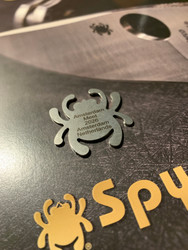
Throughout the event there were also a few trivia contests testing the audience’s level of Spyderco knowledge. Prizes included knives, hats, shirts and other Spyderco gear. Every attendee also received a generous gift bag containing a commemorative Amsterdam Meet 2026 coin, a Charisma pin, the 2026 Spyderco catalogue, Reveal 20, a Bodacious patch, several stickers, a Spyderco fiftieth anniversary bag and a Spyderco Endela in CPM SPY27.
For me personally the entire experience was unforgettable. It is rare to get such a direct and open insight into how a company like Spyderco approaches design, manufacturing and innovation. What stood out more than anything was the passion that Eric and Lisa clearly have for both the knives they produce and the community that surrounds the brand.
I feel incredibly fortunate to have been able to attend the Spyderco Amsterdam Meet this year and I am deeply grateful to Eric, Lisa, Mr. Blonde and everyone involved in organising the event. It was also a pleasure to meet so many fellow Spyderco enthusiasts from across Europe and beyond. Experiences like this remind you that behind every knife is not just a design and a factory, but a global community of people who share the same appreciation for well made tools.