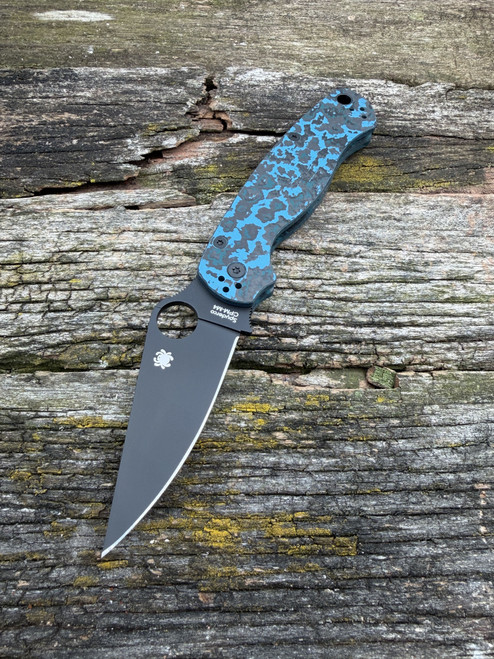
CPM M4
CPM M4: A Modern Classic Among High-Performance Tool Steels
Before the current generation of exotic knife steels began appearing in every new product announcement, CPM M4 had already earned its place among serious knife enthusiasts.
M4 is not stainless, nor was it designed specifically for knives. It is a high-speed tool steel developed for demanding industrial applications, where the ability to maintain a cutting edge under severe conditions is critical. Its journey from industrial tooling to premium folding knives is a particularly interesting chapter in the history of modern blade steel.
For enthusiasts, M4 occupies a fascinating position. It offers exceptional wear resistance and edge retention while retaining considerably more toughness than many of the extreme wear-resistant steels that followed it.
Perhaps most importantly, M4 has a reputation for taking an exceptionally aggressive, responsive edge. For those who enjoy actually using and sharpening their knives, that characteristic has made CPM M4 something of a cult classic.
The Origins of CPM M4
CPM M4 was developed by Crucible Industries as a powder metallurgy high-speed tool steel.
Its origins are firmly rooted in industrial cutting tools rather than pocket knives. High-speed steels are designed to maintain hardness and cutting performance under demanding conditions, particularly where conventional tool steels would rapidly lose their edge.
Crucible's CPM process allowed M4 to be produced with a fine and uniform distribution of carbides, improving the steel's combination of wear resistance and toughness. The result was an industrial steel capable of extremely high hardness while retaining useful toughness.
Knife makers eventually realised that those characteristics translated remarkably well to cutting tools and so M4 found a second life in the world of premium knives.
Why M4 Became So Popular With Knife Enthusiasts
M4 does not rely upon extreme levels of alloying to achieve its performance. Instead, its reputation comes from an exceptionally well-balanced combination of hardness, carbide structure and heat treatment.
The steel can be hardened considerably higher than many conventional stainless steels, and that high hardness contributes significantly to its edge stability and cutting performance. In practical terms, an M4 blade can take an exceptionally keen edge and hold it through substantial amounts of cutting.
Its combination of:
- Excellent edge retention
- High achievable hardness
- Strong toughness
- Excellent edge stability
- Aggressive cutting performance
- Ease of maintenance
These properties have made M4 a firm favourite among enthusiasts who prioritise cutting performance above all else.
The Shawn Houston Connection
M4 also occupies an interesting place in the development of modern steel enthusiasm because of the work of Shawn Houston, a respected custom knifemaker and steel performance specialist. Houston became particularly interested in the relationship between hardness and real-world knife performance. M4 played an important role in that work because it demonstrated that a relatively modest-looking chemical composition could produce remarkable cutting performance when properly heat treated.
The lesson was important:
Steel chemistry is only part of the equation.
Hardness, heat treatment, geometry and edge finishing can dramatically influence how a blade actually performs.
This philosophy later became particularly influential in the development and promotion of steels such as CPM 15V.
Exceptional Edge Retention
M4's most obvious strength is wear resistance. The steel contains substantial quantities of tungsten, molybdenum and vanadium, producing a carbide structure capable of resisting abrasive wear extremely effectively.
For the user, this translates into excellent edge retention. M4 will comfortably outperform conventional stainless steels such as VG-10, 154CM and many of the more general-purpose steels when cutting abrasive materials for extended periods.
It is particularly well suited to users who value cutting longevity but don't necessarily want to jump all the way to an extreme steel such as Maxamet or CPM 15V.
M4 Is Tougher Than Its Edge Retention Suggests
One of the reasons M4 remains so highly regarded is that its impressive wear resistance does not come at the cost of all practical toughness.
It isn't a pry-bar steel, and it shouldn't be treated as one, but M4 can withstand considerably more demanding use than its excellent wear resistance might suggest.
This makes it particularly interesting for knives where the designer wants to combine:
thin geometry + high hardness + excellent edge retention.
Spyderco has made extensive use of precisely that combination.
The Edge M4 Takes
Ask experienced M4 users why they keep coming back to it and the answer often isn't simply "edge retention".
It is the quality of the edge.
Properly sharpened M4 can develop an extremely keen and aggressive cutting edge. It responds well to good sharpening technique and can be particularly rewarding for enthusiasts who enjoy maintaining their own knives. This characteristic helped M4 develop its cult following long before the current obsession with steel comparison charts.
For someone who appreciates the actual sensation of cutting with a properly sharpened blade, M4 remains a fascinating steel.
The Major Trade-Off: M4 Is Not Stainless
There is one important caveat.
CPM M4 is not a stainless steel.
It contains substantially less chromium than stainless blade steels and can develop patina or corrosion if exposed to moisture and subsequently neglected.
This isn't necessarily a disadvantage. For many enthusiasts, the possibility of developing a patina is part of the character of a high-performance tool steel.
But M4 does require more care than steels such as:
If you're carrying an M4 knife regularly, particularly in a damp environment, keeping the blade clean and lightly protected is sensible.
CPM M4 vs MagnaCut
M4 and MagnaCut illustrate two very different approaches to knife steel design. M4 prioritises high hardness, wear resistance and cutting performance while accepting that it is not stainless.
MagnaCut was specifically engineered to provide an unusually strong combination of toughness, corrosion resistance and edge retention.
For a maritime environment, MagnaCut is the obvious choice.
For a user who wants maximum cutting performance and doesn't mind maintaining a non-stainless blade, M4 remains extremely compelling. Neither is simply "better", they were designed around different priorities.
CPM M4 vs CPM 15V
M4 also provides an interesting reference point for understanding CPM 15V.
Both are high-performance tool steels with impressive wear resistance, but 15V takes the concept considerably further through its extraordinary vanadium carbide content.
The trade-off is that 15V is substantially more demanding to sharpen and is generally less forgiving. M4 therefore remains a remarkably practical alternative. It provides exceptional cutting performance without moving quite so far towards the extreme end of the steel spectrum.
For many users, that makes M4 the more enjoyable steel to actually own and use.
Spyderco and CPM M4
Spyderco has played a major role in establishing M4 as a serious production knife steel. The company has repeatedly used M4 in models designed around demanding cutting performance, including highly sought-after Sprint Runs and Exclusives.
The Spyderco Paramilitary 2 Tanto CPM M4 is particularly well known among enthusiasts and has become one of the classic examples of the steel. Other Spyderco models have also appeared in M4 over the years, making the steel an important part of Spyderco's history of experimenting with high-performance tool steels.
For collectors, discontinued M4 Sprint Runs can be particularly interesting.
A Steel With a Cult Following
M4 isn't fashionable because it is new. Quite the opposite. It has been around long enough to establish a genuine track record, and enthusiasts have had years to discover what it does well.
It isn't the most stainless steel.
It isn't the toughest.
It isn't the highest-wear steel.
But it does something that is increasingly difficult to find in modern knife steels: it is extremely good at being a knife steel.
It takes a superb edge, holds it for a long time, can be hardened aggressively and offers a compelling combination of wear resistance and toughness. For users who are prepared to accept the maintenance requirements of a non-stainless steel, CPM M4 remains one of the great high-performance blade steels.
Frequently Asked Questions
What is CPM M4 steel?
CPM M4 is a powder metallurgy high-speed tool steel produced by Crucible Industries. It is renowned for high hardness, excellent wear resistance, strong edge retention and good toughness.
Is CPM M4 stainless?
No. CPM M4 is a non-stainless tool steel and can develop patina or corrosion if exposed to moisture without appropriate care.
Why is M4 so popular for knives?
M4 offers an excellent combination of hardness, edge retention, wear resistance and toughness. It also takes an exceptionally keen and aggressive edge.
Is M4 better than S30V?
M4 generally offers greater edge retention and toughness at high hardness, but S30V has substantially better corrosion resistance and is easier to maintain.
Is M4 better than MagnaCut?
They have different strengths. M4 prioritises hardness and cutting performance, while MagnaCut provides exceptional toughness and corrosion resistance alongside strong edge retention.
Is M4 difficult to sharpen?
M4 is more difficult to sharpen than conventional stainless steels, but it is considerably less challenging than extreme wear-resistant steels such as CPM 15V, Maxamet and Rex 121. Diamond or CBN abrasives work particularly well.
Does CPM M4 rust?
Yes. M4 is not stainless and should be kept clean and dry. A light protective oil can be useful for users carrying M4 knives in damp environments.
What Spyderco knives are available in M4?
Spyderco has produced a number of M4 models, including highly sought-after Sprint Runs and Exclusives. The Para Military 2 is one of the best-known examples.
Is CPM M4 good for EDC?
Yes, provided you are comfortable with the additional maintenance required by a non-stainless steel. Its combination of cutting performance, edge retention and toughness makes it an excellent EDC steel.